
Artificial intelligence and machine learning are frequently used interchangeably in today’s IT environment. But knowing the difference between these two is important if you want to understand how modern software actually functions.
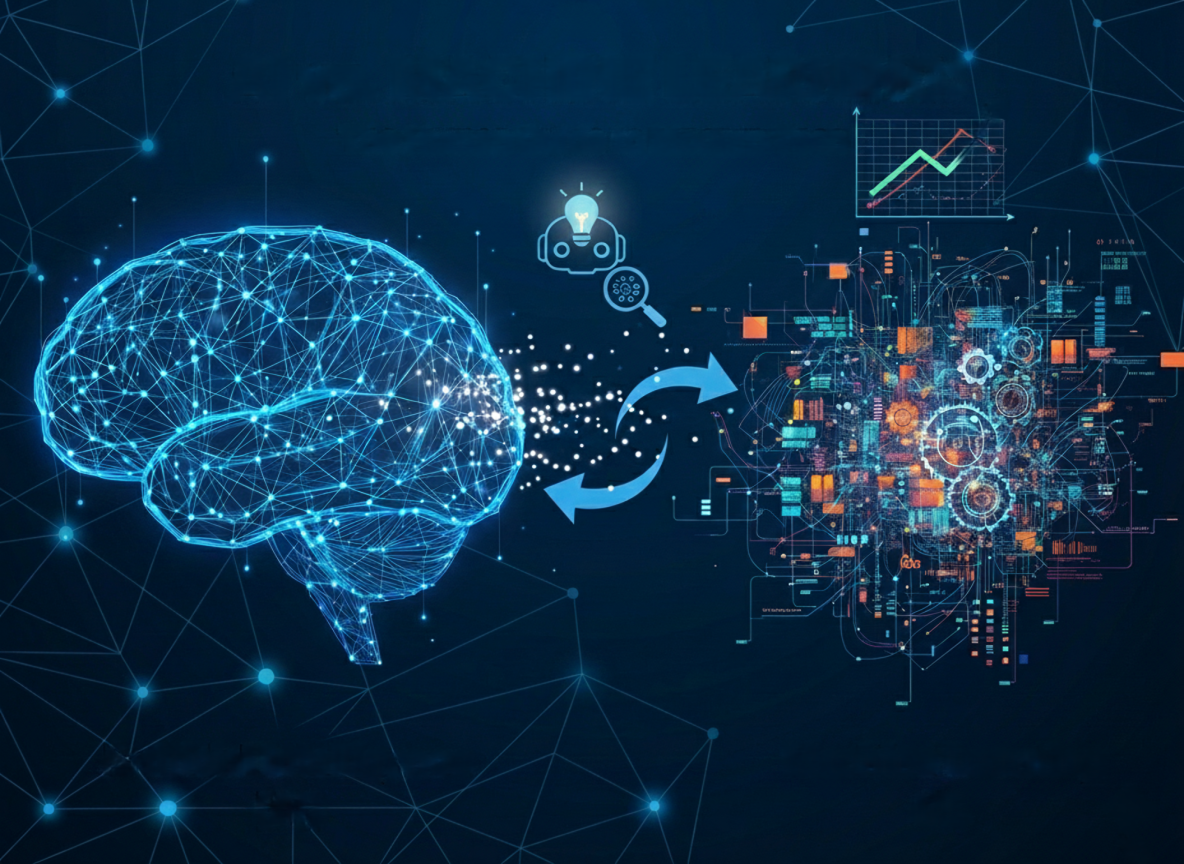
At its most basic, Artificial Intelligence (AI) is the concept of developing machines that can mimic human intelligence. Machine Learning (ML) is a specific technique for achieving intelligence through data-driven algorithm training.
Consider machine learning as the experience of driving thousands of miles to understand how to negotiate a rainy turn and artificial intelligence as the vision of a self-driving automobile.
Key Takeaways
- AI is the Umbrella: It covers any machine that can mimic human logic or behavior.
- ML is the Engine: It is a method of teaching AI to improve through data without being explicitly programmed for every task.
- Data is the Fuel: While some AI can run on rigid rules, Machine Learning requires vast amounts of data to be effective.
- Interdependence: Most modern AI “breakthroughs” we see today (like ChatGPT or facial recognition) are powered by Machine Learning.
What Exactly is Artificial Intelligence (AI)?
Artificial intelligence is a branch of computer science that aims to create systems capable of performing tasks that typically require human intelligence. This includes things like visual perception, speech recognition, decision-making, and language translation.
Historically, AI was “symbolic” or “rule-based.” Humans wrote thousands of “if-then” statements to tell a computer how to behave. While this made the machine look “smart,” it couldn’t adapt. If it encountered a situation the programmer hadn’t anticipated, the AI would fail.
Today, we categorize AI into two main types:
- Narrow AI (Weak AI): Designed for a specific task, like Siri or a chess computer. This is the only type of AI that exists today.
- General AI (Strong AI): A theoretical machine that could perform any intellectual task a human can. We are not there yet.
What is Machine Learning (ML)?
Machine Learning is the “how” behind modern AI. Instead of giving a computer a set of rules, we give it a set of examples (data) and a goal. The computer then identifies patterns in that data to figure out how to reach the goal.
The defining characteristic of ML is self-improvement. The more data an ML model processes, the more accurate its predictions become. If you show an ML algorithm 10,000 photos of cats, it eventually learns the “essence” of a cat, the ears, the whiskers, the tail, without you ever having to define those features manually.
How It Works: A Simple Explanation
To understand the difference in practice, let’s look at how two different systems might handle a Spam Filter.
The Traditional AI Approach (Rule-Based)
A programmer writes a list of rules:
- “If the email contains the word ‘Winner,’ move it to spam.”
- “If the email is from an unknown sender and has an attachment, move it to spam.”
The Problem: Spammers are smart. They will start writing “Winnner” with three ‘n’s to bypass your rule. You would have to manually update the code every single day.
The Machine Learning Approach
You show the computer 100,000 emails that humans have already marked as “Spam” and 100,000 that are “Safe.”
- The ML algorithm looks at every word, the time of day, the sender’s IP address, and the link structure.
- It notices that spam emails often use certain font colors or specific combinations of words.
- When a spammer changes “Winner” to “Winnner,” the ML model notices that the rest of the email’s patterns still look like spam and blocks it anyway. It “learned” the nuance.
Real-World Examples
Read More: Real-World Applications of AI
| Application | The AI Goal | The ML Process |
|---|---|---|
| Voice Assistants | To understand and respond to human speech naturally. | ML models are trained on millions of hours of human speech to recognize accents and context. |
| Medical Diagnosis | To identify diseases in X-rays or MRIs. | Algorithms analyze thousands of labeled medical images to “learn” what a tumor looks like compared to healthy tissue. |
| Fraud Detection | To stop unauthorized credit card transactions. | ML monitors your “normal” spending habits (location, amount, frequency) and flags anything that deviates from the pattern. |
Benefits and Limitations
Benefits
- Efficiency: AI can process data and perform tasks 24/7 without fatigue.
- Personalization: ML allows services like Spotify and Amazon to feel like they “know” you.
- Safety: AI can perform dangerous tasks, like defusing bombs or exploring deep-sea environments.
Limitations
- Bias: If the data used to train ML is biased (e.g., only containing data from one demographic), the AI will produce biased results.
- Lack of Context: AI doesn’t “understand” the world the way humans do; it only understands math and patterns.
- Data Privacy: ML requires massive amounts of user data, raising significant privacy concerns.
Frequently Asked Questions(FAQs)
1. Is Alexa AI or Machine Learning?
Alexa is a form of AI that heavily utilizes Machine Learning. The AI is the overall interface that converses with you, while Machine Learning is used for speech recognition (understanding your voice) and natural language processing (understanding your intent).
2. Can you have AI without Machine Learning?
Yes. Early AI systems, like the Deep Blue chess computer, used “expert systems” and hard-coded rules. They were intelligent in their specific domain, but did not “learn” from their mistakes in the way ML does.
3. Which is better for businesses: AI or ML?
It depends on the goal. If you need simple automation (like a chatbot that answers 10 standard questions), basic AI/rules are enough. If you need to predict future trends, analyze customer behavior, or recognize images, you need Machine Learning.
Conclusion
Artificial Intelligence is the “What” of the ambition to make machines smart. Machine Learning is the “How” of the statistical engine that allows those machines to learn from experience.
As we move forward, the line between them will likely continue to blur, but remembering that ML is just one (very powerful) tool in the AI toolbox will help you navigate the future of technology with confidence.